
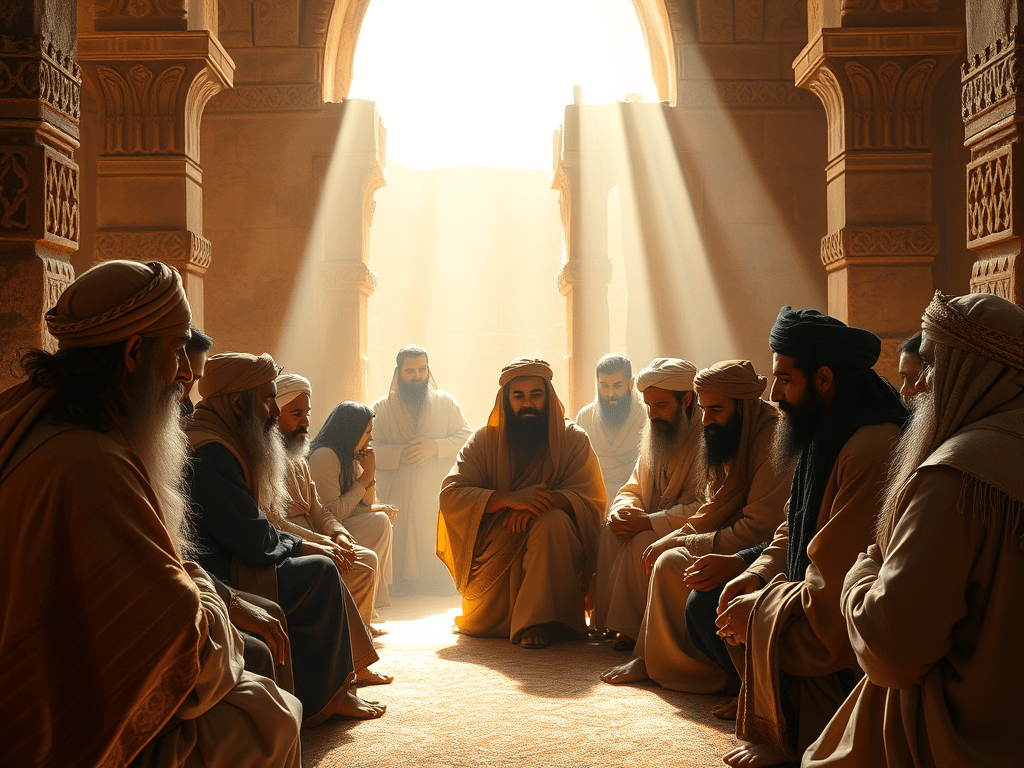
Over the next several weeks, I will be exploring the topic of titles used to describe God’s people throughout the Bible, but primarily titles used for his first century people in the writings of the New Testament. These terms do indeed all have significance and definitions are important, which is why I am taking the time to break down biblical terms so we can have a better grasp of how to apply them appropriately.
We will be looking at the following terms in some detail: believer and Christian, the Remnant and the Elect, the Church and the Body, and the Bride of Christ. These are all terms that by most accounts are considered synonymous and applicable to the people today who claim to believe in Messiah. However, I intend to look at scriptural reasons as to why I believe this is not the case, how most of those terms do not apply to God’s people today, and yet how God has worked within these various aspects of his people over the ages to accomplish specific things for the good of all.
As is usually the case, I began this as a single essay, but as I continued to delve into the particulars of these various designations I found that more and more details would present themselves for further study. Hopefully, breaking some of these up into smaller segments will be easier to grasp the essential points along with some relatively unusual perspectives for further study on your own.
Believers
Let’s begin with a basic term that is used to describe God’s people throughout the Bible: belief. You may notice that generally when I speak of those who follow Yahweh and Messiah Yeshua, I choose to use the term believers rather than Christians. This is the one term out of all of those previously mentioned which I believe does apply to God’s people today. This stems from the thrust of the biblical narrative and some particulars about the designation of Christian (which we will explore in a little bit).
All throughout the Bible there are people who are listed as those who believe and also those who do not believe.
Exodus 4:5 – “This will take place,” he continued, “so that they will believe that Yahweh, the God of their ancestors, the God of Abraham, the God of Isaac, and the God of Jacob, has appeared to you.”
Deuteronomy 9:23 – “When Yahweh sent you from Kadesh-barnea, he said, ‘Go up and possess the land I have given you’; you rebelled against the command of Yahweh your God. You did not believe or obey him.
2 Kings 17:14 – But they would not listen. Instead they became obstinate like their ancestors who did not believe Yahweh their God.
Psalm 78:32 – Despite all this, they kept sinning and did not believe his wondrous works.
Isaiah 43:10 – “You are my witnesses” — this is Yahweh’s declaration — “and my servant whom I have chosen, so that you may know and believe me and understand that I am he. No god was formed before me, and there will be none after me.
An interesting facet to all of these belief passages in the Tanakh is that they are expressed within the context of Israel; as in, there are those who believe and who do not believe in Yahweh within the nation of Israel. It is not used as a phrase for those outside of the national identity. As we move through the discussion in the coming studies, you will see how that becomes an important understanding in terms of God’s dealings with his people, especially when we come to consider the terms “remnant” and “elect”.
In the New Testament, we find belief, especially a belief in Messiah (which is said to be an indication of receiving him) to be a core aspect of Messiah’s purpose:
John 1:11-12 – He came to his own, and his own people did not receive him. But to all who did receive him, he gave them the right to be children of God, to those who believe in his name,
John 6:29 – Yeshua replied, “This is the work of God – that you believe in the one he has sent.”
John 14:1 – “Don’t let your heart be troubled. Believe in God; believe also in me.
Followers of Messiah even used this type of descriptive terminology:
Acts 16:15 – After she and her household were baptized, she urged us, “If you consider me to be believing in the Lord, come and stay at my house.” And she persuaded us.
Acts 16:34 – He brought them into his house, set a meal before them, and rejoiced because he had come to believe in God with his entire household.
The writer to the Hebrews makes it clear that faith is essential to pleasing God:
Hebrews 11:6 – Now without faith it is impossible to please God, since the one who draws near to him must believe that he exists and that he rewards those who seek him.
The apostle Paul emphasized that belief was the foundation of the collective group of those who were in Messiah:
Romans 3:22 – The righteousness of God is through faith in Yeshua Messiah to all who believe, since there is no distinction.
But then, in another passage, Paul draws a more specific distinction between those who were to be considered believers with those who were non-believers. In contrast with the Tanakh passages which seemed to focus on believers and non-believers within the nation of Israel, Paul appears to be discussing non-believers in the wider context of the general population of Corinth, known for its idolatry.
2 Corinthians 6:14-15 – Do not be yoked together with those who do not believe. For what partnership is there between righteousness and lawlessness? Or what fellowship does light have with darkness? What agreement does Messiah have with Belial? Or what does a believer have in common with an non-believer?
Now, it could be argued that Paul was addressing those who claimed to be among the scattered Israelites in Corinth who gave lip service to Yahweh and yet were just as likely to be found among the idolatrous temples of the culture around them. In this passage, Paul uses this unusual term Belial, along with lawlessness and darkness, as contrasting terms to Messiah. Since this appears to be the only place this term Belial is used in the New Testament Greek, if we pursue this term back to its Hebrew root, we find it less of a proper name and more of a description of those who were considered wicked or worthless.
Deuteronomy 13:12-14 – “If you hear it said about one of your cities Yahweh your God is giving you to live in, “that wicked men have sprung up among you, led the inhabitants of their city astray, and said, ‘Let’s go and worship other gods,’ which you have not known, “you are to inquire, investigate, and interrogate thoroughly…
1 Samuel 2:12 – Eli’s sons were wicked men; they did not respect Yahweh
2 Samuel 23:6 – But all the wicked are like thorns raked aside; they can never be picked up by hand.
2 Chronicles 13:7 – “Then worthless and wicked men gathered around him to resist Rehoboam son of Solomon when Rehoboam was young, inexperienced, and unable to assert himself against them.
Proverbs 6:12 – A worthless person, a wicked man goes around speaking dishonestly,
Nahum 1:11 – One has gone out from you, who plots evil against Yahweh, and is a wicked counselor.
Sometimes the term used in these passages is the phrase ben belial, meaning “a son of wickedness/worthlessness”. It is from this Hebraism that the term could be considered as a proper name of some wicked entity, sometimes associated with Satan. But to be a “son of” something was to be considered the offspring of, or participant in, something larger than oneself.
Exodus 19:6 – and you shall be to Me a kingdom of priests and a holy nation.’ These are the words that you shall speak to the sons of Israel.”
- These sons of Israel weren’t just Jacob’s sons particularly, because there were also some Egyptians and others who had come out of Egypt with the Hebrews at that time, but it is here speaking of participants in the nation of Israel, much like we might say “sons of America” today.
Matthew 8:12 – “But the sons of the kingdom will be thrown into the outer darkness where there will be weeping and gnashing of teeth.”
- Here, Yeshua uses the same type of language regarding those who were considered to be participants within the Kingdom of God, yet were being rejected for their lack of faith.
To be a son in the most basic sense of the Hebrew is to be a builder, as in the builder of the family line or family name. In this sense, to be a son of the Kingdom is to be a builder of the Kingdom. To be a son of belial is to be a builder of wickedness and worthlessness. And in the passage of 2 Corinthians where Paul is drawing a distinction between those of Messiah and those of Belial, whether these individuals were simply wicked fellow citizens of their pagan culture or if they were lawless scattered Israelites, either way, these individuals are the ones whom Paul is warning believers in Messiah to stay away from.
In the Bible, it is also clear that belief is closely aligned with and only visible through actions and lifestyle. You may recall that the Tanakh passages we reviewed earlier use this phrase as a verb describing an action, believing and obeying or not believing and remaining obstinate or disobedient. In the New Testament writings, James defines this Hebraic way of understanding faith a little further:
James 2:17-18 – In the same way faith, if it does not have works, is dead by itself. But someone will say, “You have faith, and I have works.” Show me your faith without works, and I will show you faith by my works.
And this is one of the places where I get on my little hobby horse about English translations (and there are many!). In the 2 Corinthians 6 passage, Paul uses the term “non-believer” as a contrast to those who are in Messiah. Many English Bibles might phrase this statement by rendering it as “unbeliever”. While this is most likely just me splitting semantic hairs (please bear with me), this term “unbeliever” in English is a phrase which I greatly dislike because it seems imprecise when discussing this biblical concept. To me it is a nonsensical term; how can you un-believe something? You either believe it or you don’t. In the original Greek, non-believers are called apistos which literally means faithless, without demonstrating faith in Yahweh.
I think the phrase “unbeliever” bothers me because it appears to describe an inherent characteristic of unbelief, like it’s just some sort of opinion one holds. But we just saw how the Bible uses the term faith as a verb describing an action, not just a static state of being or an opinion. Those who do not believe are actively not believing, and their lifestyles and their actions show it. To say someone is apistos does not just mean they are unbelieving in opinion, they are literally without faithful actions. I know that unbeliever is an acceptable use of the term in English, but for some reason it just gets under my skin and seems inaccurate. To me, those who demonstrate by their actions that they do not believe are not “unbelievers”, they are more accurately without faithful actions and are, by default (whether knowingly or unknowingly), obstinately living in disobedience to God.
So as we begin this journey on titles used to describe God’s people, I would strongly argue that the concept of faith must be included. While biblical faith is used in the verb sense throughout the Bible, I am of the opinion that to call someone a believer in the noun sense still adequately describes who they are by what they do. My definition of a biblical believer is someone whose actions and lifestyle express their faith in Yahweh as the one true God, and in Yeshua as his Messiah, or Anointed One. A non-believer’s actions demonstrate that they have no faith in Yahweh as the one true God, or in Yeshua as the Messiah, even if they claim to be associated with believers.
Christians
While the term Christian has become an acceptable description of one who follows Christ, or the Messiah, in our present day it is actually a term that has come to mean anyone who believes a specific orthodoxy about the person of Messiah and the message of the Bible as a whole. To be a Christian today, one must affirm that they agree with a framework of stated beliefs in order to qualify as a Christian. Most congregations today even have a public “statement of faith” which defines how they choose to align with the major Christian propositions, such as the trinity, virgin birth of Messiah, and perspectives on eschatology like the end times. This is understandable, for to belong to any type of specific group one must have points of agreement in order to be in fellowship.
However, in point of fact, there is a scholarly perspective that the term Christian as it is actually used in the Bible was not a statement of belief but it was initially used as a pejorative term against the believers in the first century.
The term itself is used only in three New Testament passages:
Acts 11:26 – The disciples were first called Christians at Antioch.
Acts 26:28 – Agrippa said to Paul, “Are you going to persuade me to become a Christian so quickly? “
1 Peter 4:14-16 – If you are ridiculed for the name of Christ, you are blessed, because the Spirit of glory and of God rests on you. Let none of you suffer as a murderer, a thief, an evildoer, or a meddler. But if anyone suffers as a Christian, let him not be ashamed but let him glorify God in having that name.
Now, most people who call themselves Christians today are not aware of the academic dispute about the actual phrase used in the Greek: was it christianoi meaning “anointed ones” or “those who follow the anointed” or was the term chrestianoi meaning “good ones” or “those who do good”? There is only one letter difference in the Greek between these two terms, and based on some convincing manuscript evidence (like the Codex Sinaiticus of the 4th century), some scholars think that chrestianoi is the original or preferred rendering. Someone who is a chrestianon is considered useful, pleasant, kind, or good. Believers living out the teachings of Messiah could certainly be classified as such, since they were instructed by Messiah not only to be kind to one another, but to extend that kindness even to their enemies. This would definitely be a distinctive characteristic worthy of some unique terminology.
The influential Biblical scholar of the last century, F.F. Bruce, wrote the following in his commentary on the book of Acts:
“Xrestus (“useful, kindly”) was a common slave-name in the Graeco-Roman world. It appears as a spelling variant for the unfamiliar Christus (Xristos). (In Greek the two words were pronounced alike.)” – F. F. Bruce, The Books of Acts, 368.
We can see how there was a close correlation between the two terms, and how the term chrestianoi could be applied to those who saw themselves as slaves to that which is good, because they would be known for always doing good to others. However, in a negative connotation, a chrestianon could also have been someone whom we might call today a “goody two-shoes”, or a “do-gooder”; as someone who is annoyingly righteous in what they say and do. And to be honest, this seems to me to be the way the term was employed in Scripture.
Notice, in the passages we just reviewed how if we substitute the negative connotation for the traditional rendering of Christian, it can apply equally as well as the positive.
- Acts 11:26 – The disciples were first called Christians at Antioch.
- It could just as easily be said that the disciples were first called “do-gooders” at Antioch. This would mean that this would have been the first place that believers were recognized collectively as a group with characteristics of doing good that were unique enough to have earned the name.
- Acts 26:28 – Agrippa said to Paul, “Are you going to persuade me to become a Christian in so little time?”
- Again, if we substitute the alternative, it could be that Agrippa said to Paul, “Are you going to persuade me to becomea ‘do-gooder’ in so little time?” Agrippa, in context, is sarcastically accusing Paul of trying to convert him to become something he is not. If this “do-gooder” tag was a name that had been applied to the movement many years before, Agrippa, as a controversial politician at best, could easily be seen as conveying his unlikely conversion to being someone who is considered “doing good”.
- 1 Peter 4:16 – But if anyone suffers as a Christian, let him not be ashamed but let him glorify God in having that name.
- Peter here is contrasting the believers with those who are murderers, thieves, evildoers and those who defraud others (v. 15). “But if anyone suffers as a “doer of good”, let him not be ashamed but let him glorify God in having that name,” (v. 16). This rendering can be further substantiated by v. 19 which says, “So then, let those who suffer according to God’s will entrust themselves to a faithful Creator while doing what is good.” Peter could easily be saying the “doer of good” term was used as a way of ridiculing those who had chosen to follow the Messiah, and he is encouraging them to not be ashamed of those who would use this term in a derogatory fashion. It’s as if Peter is saying, “Don’t stop doing good just because people are making fun of you for doing so.”
To me, this does not seem to be such a difficult perspective to hold, as even today, many believers are ridiculed for having integrity and doing what is right when peer pressure or cultural dictates are otherwise. If we are truly living according to the teachings of Yeshua, then exhibiting forgiveness to others and extending compassion when it is not customary to do so can certainly be considered abrasive amidst a culture that primarily promotes self-benefit in every aspect. Some things regarding human nature don’t appear to have changed in the millennia since Messiah walked the earth, but then again, as followers of Messiah and slaves to that which is good, we are still called to be the light of the world (that which illuminates) and the salt of the earth (that which heals and preserves).
SUMMARY
Let’s summarize what we have looked at so far in this study on titles for God’s people. We saw that faith was the primary distinction of those who followed the Messiah, so using the term believers seems appropriate and right, as long as the actions of those who claim to be believers bear out their testimony. However, we noted that the term “unbeliever” seems unusual when the actual phrase used in Scripture means one who is faithless or without faithful actions, and is actively living in disobedience. We also saw how there could be both believers and faithless within the group of those considered as God’s people at any given time, based on how they demonstrated their faith (or lack of it) by their ongoing actions.
We then considered how, in today’s usage, a Christian is typically defined as one who holds to a certain set of orthodox beliefs about Christ and the Bible worldview as a whole. However, from the passages where the term may have been used in Scripture, we then saw how the term (whether meaning slave of Christ or one who does good) was likely used in a derogatory way to malign those who were known for excessive acts of kindness and charity amidst a corrupt society. As “slaves” of Christ, according to Peter, believers were to consider that term a badge of honor rather than the term of derision that it was.
Well, as we wrap up for today, I hope there are at least a couple of concepts and ideas to encourage you to meditate on and to study out further on your own. Next time, we’ll be looking at the terms “remnant and elect”, so be sure to come back and visit for more perspectives on these titles of God’s people. But remember, if you have thoughts or comments that you would like to explore further with me, feel free to email me at coreofthebible@gmail.com.
 The Core of the Bible