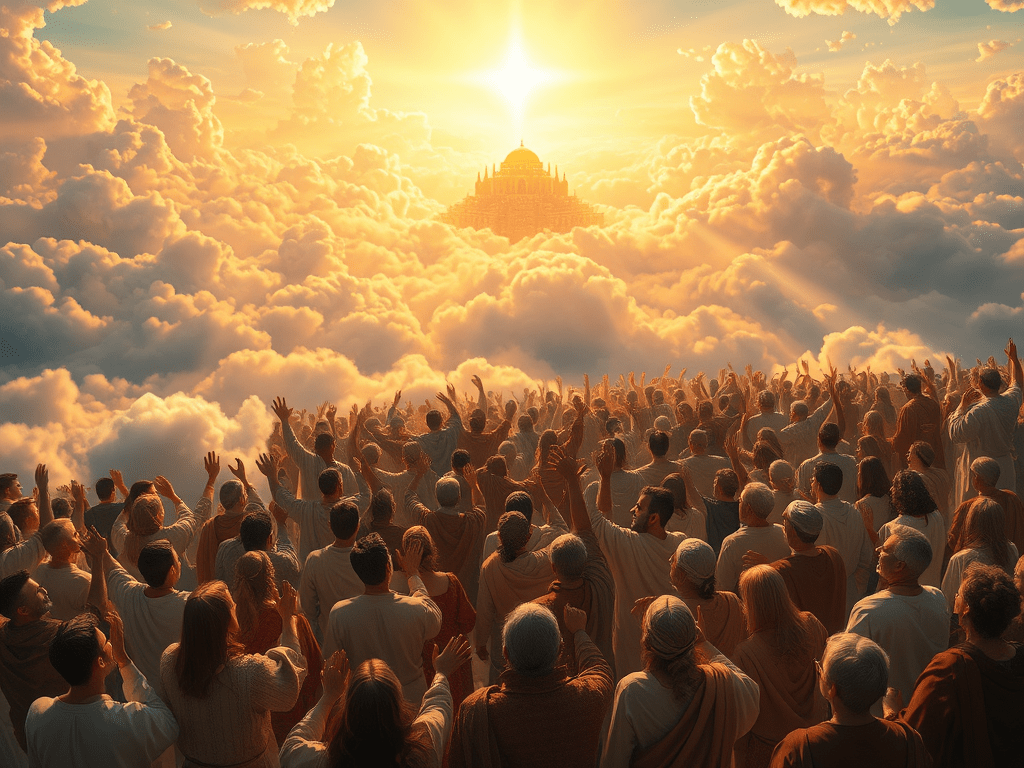
Titles for God’s People: The Church

Exploring the significance and evolution of terms such as “Church,” “Body,” and “Assembly” within biblical context.

As I mentioned previously, we are currently doing a little miniseries on the titles for God’s people. Those of you who are regular readers may wonder why it has been so long since my last article was published, so I thought a quick word might help bridge that gap. After all, it has been about a year since I started this miniseries on the titles for God’s people.

During this time, in my personal studies I have gotten off into some pretty deep rabbit holes regarding the Body of Christ specifically, and I wanted to be sure I had some sure footing before I related some of my thoughts on that title. Since the term is primarily used by the apostle Paul, I have been challenged on some of my previous notions about what he meant in using that term. After months of reading articles and commentary and cross-referencing biblical passages and Greek and Hebrew terms, I believe I have a better understanding that remains consistent with the views I have been presenting here. I just thought you should know that, as believers, we sometimes reach conclusions that can affect our entire worldview, and those are principles that we should think very carefully about.

Over these few past episodes, we have been looking at the following terms in some detail: believer and Christian, the Remnant and the Elect, and we will continue with the Church and the Body and the Bride of Christ. These are all terms that by most accounts are considered synonymous and applicable to the people today who claim to believe in Messiah. However, in these studies I have been looking at scriptural reasons as to why I believe some of those terms do not apply to God’s people today, and yet how God has worked within these various aspects of his people over the ages to accomplish specific things for the good of all.

Last time, we explored how the terms the remnant and the elect designated those through whom God was choosing to work and to whom he maintained his covenantal faithfulness, specifically in that first century generation. We now come to two more synonymous terms which are a little more abstract in nature: the Church and the Body.

Now, while I had envisioned covering both of these terms together, I have so many concepts to share about each that I have decided to break this information into two separate episodes; one on the Church and one on the Body of Christ. So let’s begin today by looking at the title for God’s people known as the Church.

TERMINOLOGY: CHURCH AND ASSEMBLY

The word itself, church, comes to us from the Greek kyriakon meaning “of the Lord”.  In the Bible, kyriakon is used only of the supper of the Lord (1 Cor. 11:20) and the Day of the Lord (Rev. 1:10). Over the centuries, the Greek has been filtered through the proto-Germanic kirika and into the Old English chiriche to become “church” in modern English. Even though the English word wouldn’t be invented until the 11th or 12th century, a thousand years earlier the concept had been generally used when speaking of houses of worship as places “of the Lord”. Today, many church buildings are still considered houses of the Lord, but we also see churches as both buildings and as organizations.

More commonly, the word typically rendered as church in the English Bible is the Greek word ekklesia, meaning “a called out assembly”. This word is almost identical in the Latin, which is where we get the term ecclesiastical as it relates to matters of church governance and organization. Based on the concepts of the remnant and the elect that we previously reviewed, it is easy to see how this idea of a “called out assembly” became associated with the believing congregations.

However, in general ancient usage, the Greek term ekklesia really had no religious connotation and was simply used to describe an assembly or meeting of persons who had been called together for a specific purpose; it could have been any type of meeting or gathering. The Strong’s definition states:

“…among the Greeks from Thucydides (cf. Herodotus 3, 142) down, [ekklesia means] an assembly of the people convened at the public place of council for the purpose of deliberating…”

This isn’t describing a religious gathering; it’s more like a civic or town hall meeting. The ancient Greeks loved to deliberate in public meetings which, for those of you who may remember some of your history and government class at school, was the origin and foundation of democratic society.

An example of this non-religious use of the term is found even within the pages of Scripture. You may recall the story of a large mob that had gathered in the amphitheater at Ephesus after the craftsmen of idols were stirring up arguments against Paul and his companions. It was only after several hours that the city clerk could stand before the crowd and get everyone to settle down and disperse.

Acts 19:39-41 – “But if you seek anything further, it must be decided in a legal assembly [ekklesia]. In fact, we run a risk of being charged with rioting for what happened today, since there is no justification that we can give as a reason for this disturbance.” After saying this, he dismissed the assembly [ekklesia].

As you can see, this “assembly” of people in Acts 19 was actually a mob that almost turned into a riot, and had nothing to do with what we would consider a church gathering. But it’s the same Greek word that is used for “church” throughout the New Testament writings in our English Bibles.

As for its more religious connotation in the Bible, the word ekklesia is sometimes used in describing a local congregation and sometimes as describing the overall group of believers in general.

  • Local: Acts 13:1 – Now in the church (assembly) at Antioch there were prophets and teachers…
  • Overall: Acts 9:31 – So the church (assembly) throughout all Judea, Galilee, and Samaria had peace and was strengthened. Living in the fear of the Lord and encouraged by the holy Spirit, it increased in numbers.

So the word, as it’s used in the biblical writings, had application for individual congregations as well as the combined consideration of all of the believing congregations in a given area. It remains in the context of each passage where it is mentioned to determine its singular or collective application.

I think it’s also important to note in this context that another word in the New Testament that was used widely of religious buildings or gatherings was the Greek word synagoge, where we obviously get the word synagogue. This word was used most typically of Jewish places of gathering or assembling, which is what the word means: “house of assembly”. We have to remember that this is where the believers depicted within the New Testament gathered; there were no separate Christian church buildings at that time.

There is even an instance in James 2:2 where the word synagoge is used of the assembly or meeting of believers in Messiah.

James 2:1-2 – My brothers, do not show favoritism as you hold on to the faith in our glorious Lord Yeshua Messiah. For if someone comes into your meeting [synagoge] wearing a gold ring and dressed in fine clothes…

But in the early centuries (200-300 years after the destruction of Jerusalem) as Imperial Christianity was on the rise, the newly sanctioned Christian movement began to distance itself more and more from Jewish terminology. It became more common to adopt the concept of the church (the kyriakon, of the Lord) as opposed to the synagogue for both the location of Christian worship and to describe the collective Christian congregations which were spreading across the world.

For us to understand the biblical heritage of the word church, we actually need to study its equivalent phrase not only in the Greek of the New Testament writings or the Latin of early church history, but also in the Hebrew of the Tanakh: the Assembly. We just saw how the ekklesia was being described in the New Testament Greek. Once we look for the “Assembly” in the Hebrew of the Tanakh, we find it present throughout the entire narrative.

THE ALL-TIME ASSEMBLY

The Assembly is actually a biblical reality that had existed for centuries before the New Testament writings. In Hebrew, the equivalent word for assembly is qahal and it is found all throughout Scripture. The first instance of the word occurs when Isaac was pronouncing a blessing upon Jacob:

Genesis 28:3 – God Almighty bless you and make you fruitful and multiply you, that you may become a company [assembly] of peoples.

This blessing, of course, harkens back to the original blessing that God pronounced to Abraham in which he would be the source of blessing to many peoples, a promise which he simply took in faith:

Genesis 12:2-3 – I will make you into a great nation, I will bless you, I will make your name great, and you will be a blessing. I will bless those who bless you, I will curse anyone who treats you with contempt, and all the peoples on earth will be blessed through you.

Genesis 15:4-6 – And behold, the word of the LORD came to him, “This man shall not be your heir; your own son shall be your heir.” And he brought him outside and said, “Look toward heaven, and number the stars, if you are able to number them.” Then he said to him, “So shall your descendants be.” And he believed the LORD; and he reckoned it to him as righteousness.

That Abraham’s descendants would be as numerous as the stars speaks to the vast nature of the assembly which would come about through his seed. From these beginnings, we find that God continued to clarify and refine his purpose through the Assembly as he brought his people to himself out of Egypt.

Deuteronomy 5:22 – “The LORD spoke these commands in a loud voice to your entire assembly from the fire, cloud, and total darkness on the mountain; he added nothing more. He wrote them on two stone tablets and gave them to me.

Deuteronomy 9:10 – “On the day of the assembly the LORD gave me the two stone tablets, inscribed by God’s finger. The exact words were on them, which the LORD spoke to you from the fire on the mountain.

Deuteronomy 10:4 – “Then on the day of the assembly, the LORD wrote on the tablets what had been written previously, the Ten Commandments that he had spoken to you on the mountain from the fire. The LORD gave them to me…

This is the original beginnings of God’s physical Assembly on the earth: the rag-tag gathering of Hebrew ex-slaves and Egyptian deserters who met with the God of the Universe at Sinai and received the summary of God’s Torah in the Ten Words, or the Ten Commandments written on two tables of stone.

EDAH – Congregation

Another Hebrew word closely associated with qahal as the assembly is edah, typically translated as congregation. These are very nuanced Hebrew terms that are sometimes even used together in the same verses as God’s people are described as coming together.

Exodus 12:6 KJV – And ye shall keep it up until the fourteenth day of the same month: and the whole assembly [qahal] of the congregation [edah] of Israel shall kill it in the evening.

Numbers 14:5 KJV – Then Moses and Aaron fell on their faces before all the assembly [qahal] of the congregation [edah] of the children of Israel.

So the “qahal edah”, the assembly of the congregation, was descriptive of the entire community of the people of ancient Israel. While both words are technically nouns, it seems that, when used together, qahal takes on a verb sense describing the act of assembling or gathering together, while edah is the community once it is assembled, or the meeting that takes place when the assembly is complete.

Beginning in the wilderness journeys and continuing through the succeeding centuries, the qahal/edah/assembly within the tribes of Israel became not just a gathering for religious purposes, but also a place of civic justice. It was in this sense that the Assembly became the gathering for the purpose of exhibiting righteous judgment throughout the land.

Numbers 15:15 – For the assembly, there shall be one statute for you and for the stranger who sojourns with you, a perpetual statute throughout your generations; as you are, so shall the sojourner be before the LORD.

Job 30:27-28 – My heart is in turmoil, and is never still; days of affliction come to meet me. I go about blackened, but not by the sun; I stand up in the assembly, and cry for help.

Proverbs 26:24-26 – A hateful person disguises himself with his speech and harbors deceit within. When he speaks graciously, don’t believe him, for there are seven detestable things in his heart. Though his hatred is concealed by deception, his evil will be revealed in the assembly.

Throughout their history, as Israel continued to exhibit unfaithfulness and was ultimately removed from their land and dispersed among the nations in judgment, their combined Assembly became smaller gatherings within the locales to which they had been brought captive. These synagogue/assemblies became prevalent in most towns to which the Jews had been scattered throughout the known world. This was evident even within the New Testament writings in the book of Acts where James explains this had been the condition for many generations:

Acts 15:21 – For from early generations Moses has had in every city those who preach him, for he is read every sabbath in the synagogues.”

During those turbulent years of exile from about 586 to 516 BC, because they had lost their central Temple worship in their homeland, the synagogues became locations of Jewish worship and also where judgments according to the law were convened. I believe history shows us that the synagogue is actually the real basis for what we generally consider churches today. In recent centuries, rural Christian churches in America functioned much as those ancient synagogues, as they were not only a place of religious worship, but they were also used as schools, places for town meetings, and sometimes court judgments in those sparse environments. Those activities still take place in synagogues today.

It was through these local assemblies that justice was meted out in their communities. I believe it was this type of synagogue assembly that Messiah referred to when working through conflict with a disruptive brother:

Matthew 18:15-17 – “If your brother sins against you, go tell him his fault, between you and him alone. If he listens to you, you have won your brother. “But if he won’t listen, take one or two others with you, so that by the testimony of two or three witnesses every fact may be established. “If he doesn’t pay attention to them, tell the assembly. If he doesn’t pay attention even to the assembly, let him be like a Gentile and a tax collector to you.

Messiah was here highlighting the judicial function of the local synagogue, the assembly of God’s people in that community, in maintaining the integrity of the congregation when conflicts would arise among its members.

So, as we can see from Scripture, when we begin investigating concepts with their original terminology we can arrive at some very different conclusions than by simply accepting the English interpretations. In this case, in exploring the root concept of church as an assembly we can see it threading its way through all of Israel’s history back to Abraham. The Assembly, as an overarching term, is simply the gathering of the holy ones, God’s people. In the Tanakh, the qahal/edah/assembly sometimes speaks of the entire gathering of God’s people in the wilderness of Sinai, or gathering for worship at the festivals, or the gathering of the judges of the people, or the gathering of the people of God at the local synagoge.

THE ASSEMBLY OF MESSIAH

Matthew 16:15-18 – He said to them, “But who do you say that I am?” Simon Peter replied, “You are the Christ, the Son of the living God.” And Jesus answered him, “Blessed are you, Simon Bar-Jona! For flesh and blood has not revealed this to you, but my Father who is in heaven. And I tell you, you are Peter, and on this rock I will build my assembly, and the powers of death shall not prevail against it.

This is the single foundational verse indicating how Messiah was intending to establish a unique assembly, his assembly. This would have been a shocking statement among the rabbinical teachers of the day, as to begin a new or unique assembly other than that which preached Moses would mean this rabbi was elevating himself to the status of Moses and breaking with the traditions of the elders.

But in doing so, he also reveals the nature of his assembly by saying “the powers of death shall not prevail against it”. You may be more familiar with the KJV rendering along the lines of “the gates of hell shall not prevail against it”. From the original Greek, the phrase can be more literally rendered the “gates of hades shall not overpower it”. The gates of hades in the ancient world mindset was the entrance to what could be translated as the “unseen world” of departed spirits. Some have interpreted this phrase to have significance as to the place where Yeshua uttered those words: supposedly in a location of pagan cultic worship known as the Gates of Hades. This would imply that whatever group Messiah was establishing, it would rise above all of the pagan idolatry present in the world. This may be a possibility, but I think the meaning is even more far-reaching than that.

Hades in Greek (Sheol in Hebrew) was the place of the dead, all of the dead, not necessarily just a place of punishment for the wicked, as the English word “hell” conveys. By saying the gates of hades (or the unseen world) would not overpower it, I think the RSV gets the intent right when it says “the powers of death shall not prevail against it”. In qualifying his assembly in this way, I believe Yeshua immediately links his assembly which he is founding to a spiritual entity, one in which the reach of death has no power. It is in this sense that the Assembly of Messiah would be different than the Assembly of Moses; in fact, it would become the spiritual fulfillment of the natural assembly of Israel. If the gates of Hades would not prevail against Messiah’s assembly, it would not be something confined to the earth, since everything and everyone here dies. This Messianic Assembly would of necessity be something greater than any physical congregation or earthly organization, even the Assembly of Moses. This would mean that his Assembly was to also be an eternal reality in a spiritual sense. When things are eternal, they can no longer be physical.

The earthly Assembly, stretching from the beginning of the Bible to the first century synagogues of the known world at that time, was to become the seed-bed for the spiritual Assembly of the Messiah. The roots of Torah would nourish these new branches and cause them to flourish, to live spiritually, where the “dead” branches of earthly traditional Mosaic teaching without faith in Yeshua as Messiah would be broken off.

Romans 11:18-20 – do not boast over the branches. If you do boast, remember it is not you that support the root, but the root that supports you. You will say, “Branches were broken off so that I might be grafted in.” That is true. They were broken off because of their unbelief, but you stand fast only through faith. So do not become proud, but stand in awe.

This spiritual Assembly of Messiah was to be an eternal entity; it had to be, as it was to live and breathe in the rarefied atmosphere of the Kingdom of God, so to speak. Its membership was to consist of those whose names were to be metaphorically “written in heaven” (Luke 10:20), in the “Lamb’s book of life” (Rev 21:27), not based in some genealogical record or synagogue membership alone here on the earth.

Paul mentions this principle of eternal things in his letter to the Corinthians:

2 Corinthians 4:18 – So we do not focus on what is seen, but on what is unseen. For what is seen is temporary, but what is unseen is eternal.

To those who believe that Yeshua is the Messiah, the Son of the living God, they have been joined to a spiritual assembly that transcends all space and time. This was not to be just an earthly, tangible assembly that Yeshua was speaking of here. Only a spiritual entity can overcome or bypass the gates of death. Because the assembly he was speaking of was a spiritual entity, then it can exist everywhere and every time throughout all ages.

Earlier, we looked at how the qahal, the edah, the synagoge and the ekklesia are all references to the physical representations of God’s people on the earth, and object lessons of God’s dealings through and among his people. The Assembly of Messiah, however, is different in character, as Yeshua defined it. It was to be impervious to the finality of death, as it was to be the spiritual entity beyond death which does not exist on the earth. This spiritual assembly was to be the true recipient of the blessing of Abraham, as Paul argued in his epistle to the Galatians:

Galatians 3:16, 26-29 – Now the promises were made to Abraham and to his offspring. It does not say, “And to offsprings,” referring to many; but, referring to one, “And to your offspring,” which is Christ. … for in Christ Jesus you are all sons of God, through faith. For as many of you as were baptized into Christ have put on Christ. There is neither Jew nor Greek, there is neither slave nor free, there is neither male nor female; for you are all one in Christ Jesus. And if you are Christ’s, then you are Abraham’s offspring, heirs according to promise.

The true heirs of the promise God made to Abraham are those who belong to his designated “seed” or “offspring”. If we are “in Messiah”, that is, if we have been baptized spiritually into his assembly, then we by default receive the blessing assigned to and intended for Abraham’s offspring. The true Church, the Assembly of Messiah, is that spiritual entity which is built upon faith in him. It does not now exist as any single corporate entity on the earth precisely because it is beyond the gates of death, and therefore eternal.

Hebrews 12:22-24 – But you have come to Mount Zion and to the city of the living God, the heavenly Jerusalem, and to innumerable angels in festal gathering, and to the assembly of the first-born who are enrolled in heaven, and to a judge who is God of all, and to the spirits of just men made perfect, and to Jesus, the mediator of a new covenant, and to the sprinkled blood that speaks more graciously than the blood of Abel.

This is, I believe, the New Testament description of the actual Church, the “assembly of the first-born”. It is a spiritual reality that was prefigured in the earthly congregational assemblies and synagogues of Israel, but it was to exist only where “just men” have been “made perfect”. This is why Paul encouraged believers to keep their gaze heavenward:

Colossians 3:1-3 – If then you have been raised with Christ, seek the things that are above, where Christ is, seated at the right hand of God. Set your minds on things that are above, not on things that are on earth. For you have died, and your life is hid with Christ in God.

The lives of believers were not to be mired in the earthly organizations of the synagogues and what we now call churches, since as earthly entities, they are all subject to dissolution and death. They are only mere shadows of the true Assembly of Messiah.

Matthew 6:31, 33 – Therefore do not be anxious, saying, ‘What shall we eat?’ or ‘What shall we drink?’ or ‘What shall we wear?’ … But seek first his kingdom and his righteousness, and all these things shall be yours as well.

Messiah’s true Church, his Assembly, exists where God reigns supreme, in his Kingdom. According to Yeshua, we are to seek first the Kingdom, not to seek first the Church or the Assembly. It is in seeking the Kingdom that we identify ourselves within the membership of the spiritual Assembly of Messiah. It is a spiritual entity which resides in God’s spiritual Kingdom, which flesh and blood cannot inherit. This is the reality in which the Church, the Assembly of Messiah, lives and thrives.

Those of us who claim to believe in Messiah thus live in a duality: physically we live in this created world to exemplify the principles of God’s Kingdom now; however, positionally we have been joined with that eternal Assembly of the Firstborn within the realm of God’s existence and Kingdom. This dual life is empowered by God’s Spirit dwelling in and among us, the driving force behind our ability to overcome the worldliness of this life while representing his righteousness.

This is the good news that Messiah claimed was the eternal life of God available to those who placed their faith in him: we already possess this eternal life.

John 5:24 CSB – “Truly I tell you, anyone who hears my word and believes him who sent me has eternal life and will not come under judgment but has passed from death to life.

John 6:40, 47 CSB – “For this is the will of my Father: that everyone who sees the Son and believes in him will have eternal life, and I will raise him up on the last day.” … “Truly I tell you, anyone who believes has eternal life.

John 17:3 CSB – “This is eternal life: that they may know you, the only true God, and the one you have sent — Jesus Christ.

Eternal life is not just unending existence, but it is a quality of life that exceeds the natural life of just being born into and living in this world. This is why it involves a process which Yeshua described as being born again, or born from above or of the Spirit. It is a quality of life that God intends for all people where he chooses to live among his people in constant communion and in harmony with his will and purpose, just as Yeshua did.

This is the Kingdom of God come to the earth.

The Biblical Calendar and Shavuot, the Festival of Weeks or Pentecost

I believe the annual biblical holidays are the true appointments with God that he has established for all eternity.

Core of the Bible podcast #109 – The Biblical Calendar and Shavuot, the Festival of Weeks or Pentecost

In today’s episode, we are continuing our doctrinal topics but taking a slight detour from our study of the nature of God to discuss the biblical holiday of Shavuot, also known as Weeks and sometimes Firstfruits. Why is this significant, and why should believers today understand the biblical calendar and the feast days?

Most Christians today do not recognize or celebrate the biblical feast days. This is due primarily to the fact that Christianity teaches that the sacrificial aspect of the rites conveyed in the Torah have been fulfilled in Messiah Yeshua. I agree one hundred percent. But “fulfilled” does not mean “done away with.” I believe the Bible teaches that in Messiah, that which was a physical requirement for ancient Israel has become a spiritual reality for all time; more on that later. But what I want to focus on first is how the biblical calendar is filled with symbolism of the Kingdom and God’s relationship with his people. I believe it is as we maintain recognition of these days that we can be reminded of God’s, and our, purpose. These days become practical object lessons that point to the totality of God’s work among his people, and his presence in this world.

The annual biblical calendar contains seven appointed times known in Hebrew as moedim, meaning seasons or appointed times. I believe the annual biblical holidays are the true appointments with God, the seasonal moedim that he has established for all eternity. They are centered around three central “feasts” or “festival gatherings:” Unleavened Bread, Weeks/Shavuot, and Tabernacles/Sukkot. These occur in the first, third, and seventh months of the annual biblical calendar.

Deuteronomy 16:16 – “All your males are to appear three times a year before Yahweh your God in the place he chooses: at the Festival of Unleavened Bread (first month), the Festival of Weeks (third month), and the Festival of Tabernacles (seventh month).”

Interestingly, these festival-gatherings follow the agrarian timelines of the early barley harvest (first month), the early wheat harvest (third month) and the ingathering of all of the remaining crops (seventh month). All of these festivals surround God’s provision for his people. These three annual gathering seasons focus on seven appointed times which are described as memorials or re-enactments to be used to keep God’s people focused on his will and purpose.

I also find it fascinating that God has placed these appointments on the annual calendar in a way that can still be recognized today, even though worldly calendars and methods of timekeeping have come and gone. I believe this is why they are described the way they are, and why we are still able to keep those appointments with him.

How are we to keep these appointments? Certainly we are not to sacrifice animals; as mentioned earlier all sacrifice has been fulfilled in Messiah. However, on these special days we can still gather together as his people to review the symbolism of those sacrifices to bring greater awareness to our understanding of our relationship with God. Whether it is through deeper fellowship and community among his people, as well as renewing our total devotion to him and consummation in his service, we can become serious about our faith by living it out as object lessons that others can see and learn from, as well. After all, as you may know from previous episodes, I believe that God’s Torah or Word is eternal, and therefore has lasting influence on those who approach the God of the Bible as his people. These should be as much a part of our doctrinal understanding as any other major proposition such as the study of who God is or the Kingdom of God.

I would like to discuss all of these biblical holidays throughout the course of the coming year, but as I record today’s podcast, we are in the season of Shavuot or Weeks, which was recently completed. It is the festival which follows Passover and Unleavened Bread by seven weeks, hence its immediate namesake in Hebrew. The day itself falls on the day following the conclusion of 49 days from the barley firstfruits. This was technically the 50th day and became known by its Greek title of Pentecost, meaning “fiftieth.” 

Many Christians may recognize Pentecost as the day the holy Spirit came upon the disciples in a powerful way, allowing them to speak in different languages to the assembled Jews in Jerusalem, telling the Good News about the Kingdom of God. It is defined by many as “the birthday of the church,” but I believe that definition is not only a misnomer about its purpose, but a misunderstanding of the nature of the day itself.

To gain a better grasp of this holiday, we need to go back to its ancient Hebrew understanding as it is related in Torah.

Leviticus 23:16-21 – “You are to count fifty days until the day after the seventh Sabbath [that is, seven weeks after the barley firstfruits] and then present an offering of new grain to Yahweh. Bring two loaves of bread from your settlements as a presentation [wave] offering, each of them made from four quarts of fine flour, baked with yeast, as firstfruits to Yahweh. You are to present with the bread seven unblemished male lambs a year old, one young bull, and two rams. They will be a burnt offering to Yahweh, with their grain offerings and drink offerings, a fire offering of a pleasing aroma to Yahweh. You are also to prepare one male goat as a sin offering, and two male lambs a year old as a fellowship sacrifice. The priest will present the lambs with the bread of firstfruits as a presentation offering before Yahweh; the bread and the two lambs will be holy to Yahweh for the priest. On that same day you are to make a proclamation and hold a sacred assembly. You are not to do any daily work. This is to be a permanent statute wherever you live throughout your generations.”

Okay, so in this detailed passage we can learn several things. Shavuot was to be a special appointed day where no customary work was done, in which the people of God would gather and sacrifices and offerings were brought to the Temple. The primary offering of this day involves two loaves of bread as a grain offering of the firstfruits of the wheat harvest. Along with the loaves are included burnt offerings, drink offerings, sacrifices for sin and sacrifices for fellowship.

How do these ancient sacrifices and offerings apply to believers today? Even though we don’t bring actual sacrificial animals before Yahweh anymore, I believe these offerings were designed by Yahweh to represent real aspects of our spiritual lives, and I think it’s important that we continue to recognize these. So let’s take a look at what each of these different types of sacrifices means from a symbolic perspective:

  • A burnt offering represents total consummation in God’s service.
  • A sin offering represents that which is a substitute for us due to our disobedience to God’s torah.
  • The trespass offering was offered for unintentional or unknown sin.
  • A fellowship or peace offering represents thankfulness for God’s mercy and enjoyment of his relationship.
  • The grain and drink offerings represent our gratitude for God’s provision as firstfruits of all he has provided us.

I think it becomes readily apparent how these emblematic sacrifices apply in the life of the modern believer. If we are to honor these appointed times throughout the year, I believe they should be memorialized in the spirit of these attributes.

There are many facets to the symbolism of the biblical moedim or appointed times, but one of the most glaring attributes relates to their numerical significance. As rich and enlightening as this can be to review, unfortunately, many people over the centuries have taken to a kind of numerology or study of biblical numbers which has become quite complex and frankly, unhelpful. Even the contemporary expression of Judaism has devised a whole system of numerology and mysticism known as Kabbalah, which is not at all what I am proposing here. I simply look for patterns in the Bible to see how they relate to and bring meaning to one another.

For example, the Bible outlines seven days in a week. Shavuot pertains to seven “sevens” of weeks. On the day of Shavuot, all of the sacrificial symbolism falls on the fiftieth day that occurs after the week of Passover and Unleavened Bread, both of which represent the miraculous rescue from the worldliness and slavery of Egypt.

Now it’s important to understand something here from a Hebraic perspective. In this worldly existence, seven is a number that represents this Creation. Why? Well, the weekly Sabbath was given to God’s people as a reminder that God is the Creator of all.

Exodus 20:8, 11 – Remember the Sabbath day, to keep it holy:  … For Yahweh made the heavens and the earth, the sea, and everything in them in six days; then he rested on the seventh day. Therefore Yahweh blessed the Sabbath day and declared it holy.

In Hebraic understanding, the weekly Sabbath is the Sabbath of Creation. Everything in this Creation is governed by the limit of a cycle of seven. For example, a week is a cycle of seven days; there are seven appointed times throughout the year occurring within a seven-month time period. Even in the broader calendrical cycle of the Bible, every seventh year was to be a sabbatical year, a year of rest for the land.

Leviticus 25:1-4 – Yahweh spoke to Moses on Mount Sinai: “Speak to the Israelites and tell them: When you enter the land I am giving you, the land will observe a Sabbath to Yahweh. “You may sow your field for six years, and you may prune your vineyard and gather its produce for six years. “But there will be a Sabbath of complete rest for the land in the seventh year, a Sabbath to Yahweh: you are not to sow your field or prune your vineyard.

Additionally, after seven “sevens” of sabbath years, or forty-nine years, the Israelites were to set aside the fiftieth year as a “Jubilee,” a sort of re-set for all economic activity, freedom for all slaves, and a realignment of all of the tribes with their heritage.

Leviticus 25:8-10 – “You are to count seven sabbatical years, seven times seven years, so that the time period of the seven sabbatical years amounts to forty-nine. Then you are to sound a trumpet loudly in the seventh month, on the tenth day of the month; you will sound it throughout your land on the Day of Atonement. You are to consecrate the fiftieth year and proclaim freedom in the land for all its inhabitants. It will be your Jubilee, when each of you is to return to his property and each of you to his clan.”

Through these we can see how the Bible relates sevens of days, sevens of weeks, sevens of months and sevens of years, but the fiftieth is something special, something that points to realities beyond these sevens of this world.

I found this editorial comment in the Voice version of the Bible, relating the nature of the Jubilee in Leviticus 25:

“The year of jubilee is a far-reaching idea in the ancient world. In the 50th year, land that has been sold to pay debts during the preceding 49 years returns to its original owners. Israelites who had to sell themselves into slavery to pay debts are set free. All debts are declared “paid in full.” The jubilee is a regular reminder to God’s covenant people that every acre of ground, every soul belongs to God, not to those rich enough to buy them.”

So, the timing of the annual festival of Shavuot also has great significance mirroring that of the sabbatical years and the year of Jubilee which focuses on the centrality of Yahweh as Creator and Owner of all that exists. Shavuot, also being based on this principle of fifty, is a fulfillment of seven weeks (seven “sevens” of days) and then takes place on “the day after the seventh sabbath,” the fiftieth day. The remembrance, this regular reminder every year of the Exodus events on this fiftieth day represents a re-set, a new beginning, freedom from captivity and a restoration of all things to the God of the universe.  In a spiritual sense, it points to realities beyond this Creation, to eternal principles that exist outside of the sevens of this world. To my way of thinking, this is a perfect illustration of what occurred on that very famous Restoration Shavuot two thousand years ago.

Let’s take a closer look at that famous Restoration Shavuot or Day of Pentecost in which the holy Spirit came upon the disciples in a powerful way, allowing them to speak in different languages to the assembled Jews in Jerusalem, telling the Good News about the Kingdom of God. I said a few moments ago that this event is defined by many as “the birthday of the church,” and that I believe that this definition is not only a misnomer about its purpose, but a misunderstanding of the nature of the day itself.

You see, to say that is the birthday of the church is to imply that the “church” never existed prior to that time. What many call the “church” today (universally speaking) is called the ekklesia in Greek terminology, and it simply means “a called out assembly.” But the ekklesia was not “born” on that day, it had existed since the times of Moses. This is revealed in the speech of Stephen in his defense before the Sanhedrin.

Acts 7:38  – “He [Moses] is the one who was in the assembly in the wilderness, with the angel who spoke to him on Mount Sinai, and with our ancestors. He received living oracles to give to us.”

If you check your King James or American Standard Versions of the Bible, you may notice that this verse here says that it was the “church in the wilderness” who received the living oracles. The translators were simply using the Greek word in a consistent fashion. But this highlights the point: if there was an assembly, something which could be called the church which was present in the wilderness with Moses, how could it have been “born” on Pentecost in the early part of the first century? I believe it can be shown that the ekklesia, the called out assembly, was always present in those through whom God was working at any given time in the biblical narrative.

For us to approximate a Hebraic understanding of this, it can be said that there has always been a faithful remnant among God’s people, even when the nation as a whole was steeped in idolatry and wickedness. For example, when Jerusalem was being attacked by Sennacherib’s Syrian army, Isaiah the prophet revealed how God would protect them:

2 Kings 19:30-31 – “The surviving remnant of the house of Judah will again take root downward and bear fruit upward. “For a remnant will go out from Jerusalem, and survivors, from Mount Zion. The zeal of Yahweh of Armies will accomplish this.”

When returning from captivity in Babylon with only the few thousand faithful who desired to reestablish the Temple, Ezra prayed the following prayer:

Ezra 9:8 – But now, for a brief moment, grace has come from Yahweh our God to preserve a remnant for us and give us a stake in his holy place. Even in our slavery, God has given us a little relief and light to our eyes.

Even the apostle Paul, in teaching about the faithful among God’s people in that day, illustrates this idea of the remnant with the story of Elijah:

Romans 11:2-5 – God has not rejected his people whom he foreknew. Or don’t you know what the Scripture says in the passage about Elijah ​– ​how he pleads with God against Israel? Lord, they have killed your prophets and torn down your altars. I am the only one left, and they are trying to take my life! But what was God’s answer to him? I have left seven thousand for myself who have not bowed down to Baal. In the same way, then, there is also at the present time a remnant chosen by grace.

This “remnant” of God’s people was the assembly at each point in Israel’s history, sometimes even down to one person and their family, such as a Noah or an Abraham, or a Jacob. God’s purpose has always been based on the assembly of those who are faithful to him, so the ekklesia throughout the ages has been comprised of those who feared and served Yahweh.

So to carry this mental understanding into the events of the first century day of Pentecost, we can see that same principle applying there: a faithful remnant, the disciples, faithful to the principles of the Kingdom which Messiah had taught them, were given miraculous abilities by the Spirit of God to testify to the truth of the gospel of the Kingdom to the rest of the Jews who had come from all over the world. This faithful remnant was not “born” on that day, but, in alignment with the Jubilee symbolism of the day of Shavuot, they were the ones proclaiming the eternal re-set, freedom from captivity to sin, and a restoration of all things through the Kingdom of God. In a sense, this was the ultimate Jubilee.

Just as the original ekklesia was comprised of those who were assembled at Sinai and heard Yahweh speak the Ten Commandments of his Kingdom which were written in stone, the renewed ekklesia on that famous Day of Pentecost proclaimed the principles of God’s Kingdom which were to be written on their hearts.

The connection between these events is further established when it can be shown that, at the receiving of the Ten Commandments, due to their rebelliousness and idolatry, three thousand people were killed.

Exodus 32:28 – The Levites did as Moses commanded, and about three thousand men fell dead that day among the people.

However, at the Restoration Pentecost, due to their obedience, three thousand people were added to the ekklesia.

Acts 2:41 – So those who accepted [Peter’s] message were baptized, and that day about three thousand people were added to them.

As another example, the big picture of the Bible story can be described in a similar type of parallelism. God established a physical Kingdom when he revealed his Ten Commandments to his assembled people at Mount Sinai. Those commandments were written in stone by his own finger. In the first century, God established an eternal, spiritual Kingdom when, through his Messiah, he revealed those principles to the to the assembled people listening to the Sermon on the Mount. These were spiritually based on the same commandments, but now they were to be written on the heart by God’s own finger, no longer in stone. These types of parallels and symbolisms are all through the Bible.

The apostle Paul, in the context of speaking about the comparison and contrast of Adam and Yeshua, states a principle that I believe carries over into a well-ordered understanding of the Bible.

1 Corinthians 15:46 – But it is not the spiritual that is first but the natural, and then the spiritual.

In the Bible, the natural things, people, and events were real things that happened to real people, just like those who heard the commandments at Mount Sinai, or those who heard Messiah preach his Sermon on the Mount. But I believe we are to look to those things as types, shadows, and examples of the spiritual realities that have become evident through the restoration of all things in Messiah Yeshua. The prophesied remnant was that first-century assembly, but with all things consummated by the destruction of Jerusalem in 70 AD, believers from that point on up until today are simply members of God’s eternal, universal Kingdom. Since the age of natural Israel ended at that time, there is no longer a “remnant” ekklesia or assembly; it had been fulfilled in that generation in that time.

When Paul illustrated his teaching with stories from Israel’s wilderness journeys, he also emphasizes the purpose of learning and re-telling these stories.

1 Corinthians 10:11 – Now these things happened to them as an example, but they were written down for our instruction, on whom the end of the ages has come.

That first century ekklesia or assembly of Messiah believers in the natural world was to become the touchstone for all future generations of believers as spiritual descendants. The ancient biblical ages, the ages of Abraham, Moses, and of natural Israel, were coming to a consummation in the soon destruction of the city in 70 AD. Beyond that event, the spiritual principles of the Bible would be cast forward into the future, lighting the way for all future generations of believers as the eternal Kingdom of God would continue to spread throughout the world.

So I believe that Shavuot has not been done away, nor have any of the other biblical holidays, but I believe they have been renewed and elevated in this great spiritual restoration accomplished by Messiah. Paul writes how even believers were to view themselves as having been completely renewed within their faith in Messiah.

2 Corinthians 5:17 – Therefore, if anyone is in Messiah, he is a new creation. The old has passed away; behold, the new has come.

In Messiah, all things are new now, not just in the future!

So as we view this seasonal moed or appointed time of Shavuot, we can catch a glimpse of its renewed nature and purpose in the symbolism of its biblical parameters. That first-century restoration Pentecost was the fulfillment of the Jubilee symbolism, the fifty beyond the sevens and forty-nines of this world, declaring the eternal nature of the Kingdom of God. Just as Yeshua taught, this was to be a Kingdom based on the structure of the Ten Commandments, as both a near and present reality, a realm where vigilance would be required of those who sought to participate. These believers would be set apart and holy, trusting God for all of their needs, just as he did, and they would operate with God’s characteristics of forgiveness and compassion, demonstrating that they are the children of God.


Well, I hope this brief introduction to the biblical holidays and the restoration Shavuot or Pentecost brought you some concepts and ideas to meditate on and to study out further on your own. But remember, there is also a Core of the Bible virtual Bible study group that is hosted through the Marco Polo video chat app. It is designed to discuss the topics that we cover each week and to help people with responses to questions that may come up. If you are interested in joining the discussion, simply download the free Marco Polo app and email me a request to join the group at coreofthebible@gmail.com. I will be happy to send you a link to join the virtual Bible study group. You can also feel free to email me any of your thoughts or comments at that email, as well.

Purity of heart through the Word of God

If we are to remain holy and blameless, we need to remain steadfast in the faith which has been handed down to this generation.

Matthew 5:8 – “Blessed are the pure in heart, for they will see God.

Purity of heart is what sets believers apart, what makes them holy. Purity and blamelessness are characteristics of a life that has been changed and influenced by the power of God’s presence and his Word.

Ephesians 5:25-27 – Husbands, love your wives, just as Messiah loved the congregation and gave himself for her to make her holy, cleansing her with the washing of water by the word. He did this to present the congregation to himself in splendor, without spot or wrinkle or anything like that, but holy and blameless.

Psalm 24:3-6 – Who may ascend the mountain of Yahweh? Who may stand in his holy place? The one who has clean hands and a pure heart, who has not appealed to what is false, and who has not sworn deceitfully. He will receive blessing from Yahweh, and righteousness from the God of his salvation. Such is the generation of those who inquire of him, who seek the face of the God of Jacob.

Seeking the face of the God of Jacob and inquiring of his Word; these are the characteristics of the congregation of the Messiah, the ekklesia, or the assembly of called-out ones. The congregation of the Messiah was the example for all those who would come to faith through their testimony and witness. They were set apart through the Word of God, and through the sacrificial example of the Messiah.

Colossians 1:21-23 – Once you were alienated and hostile in your minds expressed in your evil actions. But now he has reconciled you by his physical body through his death, to present you holy, faultless, and blameless before him ​– ​ if indeed you remain grounded and steadfast in the faith and are not shifted away from the hope of the gospel that you heard. This gospel has been proclaimed in all creation under heaven, and I, Paul, have become a servant of it.

If we are to remain holy and blameless, we need to remain steadfast in the faith which has been handed down to this generation. God’s Word is maligned in the marketplace of ideas in which we live, but its timeless truths stand forever. Just as the apostle Paul became a servant of the good news of God, we also demonstrate its power when we live obediently by its dictates, when we show the world that we are inherently different through the Word that has changed our hearts. Our loving actions toward one another are the distinction that can illustrate the truth of God’s Word to a world in desperate need of stability and hope.

Philippians 2:14-16 – Do everything without grumbling and arguing, so that you may be blameless and pure, children of God who are faultless in a crooked and perverted generation, among whom you shine like stars in the world, by holding firm to the word of life…


If you enjoy these daily blog posts, be sure to visit the growing archive of the Core of the Bible podcast. Each week we take a more in-depth look at one of the various topics presented in the daily blog. You can view the podcast archive at https://core-of-the-bible.simplecast.com/ or your favorite podcast streaming service.

Now also on YouTube! Just getting started, but new videos will be added regularly on many different topics, find us at: https://www.youtube.com/channel/UCvR_aNEyA7WEZJtF4B8fZ6g

Questions or comments? Feel free to email me directly at coreofthebible@gmail.com.